Protecting Your Feet
Lesson Plan 4165
A. Lesson Goal:
By the end of the training session, workers will:
- Understand the foot hazards they face on the job.
- Know how to select the proper footwear to protect against these hazards.
- Recognize the kinds of shoes that are inappropriate to wear to work.
B. OSHA Regulation: 29 CFR 1910.136
C. Have Handy:
- Samples of approved safety shoes
- Samples of shoes that should not be worn on the job (for example, sandals, worn-out sneakers, dress shoes)
D. Background for Instructor:
1. Introduction
The Bureau of Labor Statistics reports that in one recent year there were 78,000 foot and toe injuries that caused employees to miss days from work. That works out to about 200 foot injuries a day and a lot of lost productivity. How likely is one of those injuries to occur in your department? That depends on the foot hazards in your workplace and the steps you are taking to train workers to protect their feet.
2. What Are the Hazards?
There are numerous foot hazards in most workplaces. All employees, for example, need protection from slipping and falling hazards. In addition, there are specific hazards related to various jobs that put employees at risk for foot injuries:
- Employees who work with or around heavy equipment or perform materials handling duties have to be additionally concerned about protecting their feet and toes from heavy falling objects or objects like barrels or drums rolling over their feet.
- Some workers need to protect their feet from nails and other sharp objects that could puncture their shoes.
- Employees who work on wet surfaces must be extra careful about slipping hazards.
- Employees who work with electricity need to be concerned about getting electrical shocks.
- Workers who use or handle hazardous substances must protect against chemicals that could penetrate normal shoes.
3. Make Sure Employees Are Wearing the Right Kind of Footwear for the Job
The OSHA regulations require employers to ensure that “each affected employee shall wear protective footwear when working in areas where there is a danger of foot injuries due to falling or rolling objects, or objects piercing the sole, and where such employee’s feet are exposed to electrical hazards.” That means it is your job to make sure your employees wear the right shoes for the job. For example, employees should wear:
- Sturdy shoes with impact-resistant toes, low heels, and nonskid soles no matter what their job, to protect their feet against general workplace hazards.
- Safety shoes with a toe box specially designed to withstand the impact of heavy objects if they work around heavy equipment or perform materials handling jobs. (Note: The ANSI standard for safety-toe footwear referred to in the OSHA regulations deals with the strength of the toe box. The top classification, 75, will withstand the impact of 75 pounds per square inch falling on the foot.)
- Shoes with metal insoles or reinforced soles for puncture hazards.
- Shoes with nonconducting soles if they work with electricity.
- Rubber boots or shoes or leather shoes with wooden soles if they work on wet surfaces.
- Heat-resistant soles if they work on hot surfaces.
- Footguards over their work shoes when these protectors are assigned.
- Gaiters if they work in jobs where they could be splashed by hot metal or welding sparks.
- Impermeable rubber or neoprene boots if they work with corrosives or hazardous chemicals.
4. Monitor the Use of Unsafe Footwear
To make sure that employees’ feet are always well protected on the job, you need to monitor their footwear to make sure that they are not wearing the wrong shoes for the job or inappropriate shoes for the workplace. Inappropriate workplace footwear includes:
- Shoes that are torn, worn down, or otherwise offer less than full protection
- Sandals
- Old, run-down dress shoes
- Street shoes unless they are approved for the job
5. Conclusion
Feet are a frequently ignored—and often injured—part of the body. Don’t let your employees forget their feet when they are thinking about safety on the job. Make sure that they are always wearing the right shoes for the job. And check to be sure that their footwear is always in good condition so that it will afford the necessary degree of protection.
E. Examples and Practical Exercises:
- Discuss the various foot hazards in your workplace.
- Display samples of the different kinds of safety footwear employees may need to use on the job and explain the special safety features of each type.
- Review the types of shoes that should not be worn on the job.
A Safety Meeting Outline
A. Introduction (2 minutes)
- Feet are a frequently ignored—and often injured—part of the body.
- There are numerous foot hazards in the workplace.
- You can protect yourself against these hazards by always wearing the right kind of footwear for the job.
B. Hazards (2 minutes)
- Slips and falls
- Heavy objects falling on the foot
- Objects rolling over the foot
- Puncture wounds from nails and other sharp objects
- Electrical shock
- Hazardous substances
C. Protection Against Hazards (10 minutes)
(Distribute and review handout 4165-25, or use as an overhead slide.)
Handout 4165-25
D. Practical Exercise and Discussion (5 minutes)
- What are some of the foot hazards you face on your job?
- What type of foot protection do you need to protect your feet against those hazards?
- What type of footwear should you avoid wearing to work?
E. Summary (2 minutes)
- Foot protection is an important part of overall personal safety that is often neglected by many workers.
- At the very least, you should wear sturdy shoes with impact-resistant toes, low heels, and nonskid soles to protect your feet against general workplace hazards.
- Where specific hazards exist in your job, you will require other types of foot protection specially designed to protect your feet against those hazards.
F. Wrap-Up (5 minutes)
- Thank employees for their participation.
- Ask for final questions and answers.
- Issue and collect session evaluation form.
Take Steps to Protect Your Feet!
Although you depend more on your feet to get you around than you do your car, you probably pay more attention to the tires on your vehicle than you do to the shoes on your feet. But your shoes are an important safety feature. Depending on the kinds of hazards you face on your job, you may need to rely on different kinds of safety shoes.
To keep your feet safe no matter what the job, wear comfortable shoes in good condition and remember these tips:
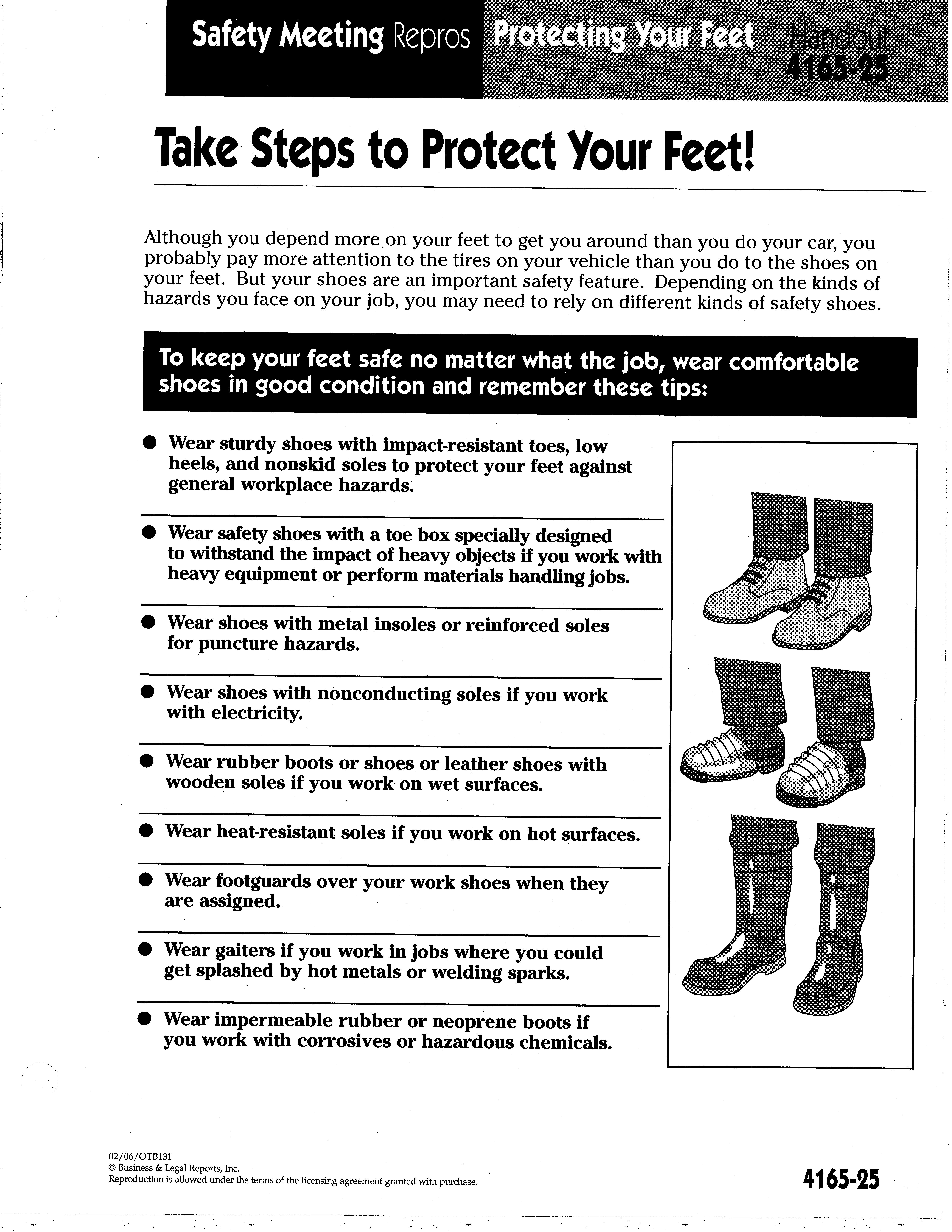
- Wear sturdy shoes with impact-resistant toes, low heels, and nonskid soles to protect your feet against general workplace hazards.
- Wear safety shoes with a toe box specially designed to withstand the impact of heavy objects if you work with heavy equipment or perform materials handling jobs.
- Wear shoes with metal insoles or reinforced soles for puncture hazards.
- Wear shoes with nonconducting soles if you work with electricity.
- Wear rubber boots or shoes or leather shoes with wooden soles if you work on wet surfaces.
- Wear heat-resistant soles if you work on hot surfaces.
- Wear footguards over your work shoes when they are assigned.
- Wear gaiters if you work in jobs where you could get splashed by hot metals or welding sparks.
- Wear impermeable rubber or neoprene boots if you work with corrosives or hazardous chemicals.
Foot Protection Quiz
After the following statements, write T for True or F for False:
- OSHA doesn’t have any regulations concerning foot protection.
- No special foot protection is necessary for most jobs.
- People who work with hazardous substances should wear work shoes with metal insoles.
- If your job involves the risk of heavy objects falling on your feet and toes, you should wear rubber or neoprene boots.
- Shoes with nonconducting soles should be worn when working with electricity.
- It’s safe to wear sandals to work in the summer if you don’t work around heavy objects and are really careful.
- In most cases, your street shoes are acceptable footwear for work.
- You should wear rubber boots or shoes or leather shoes with wooden soles if you work on wet surfaces.
- Footguards are the best choice to protect your feet against puncture wounds.
- You should wear impermeable rubber or neoprene boots if you work with corrosives or hazardous chemicals.
Name (please print)
Signature
Date
Answers
-
OSHA doesn’t have any regulations concerning foot protection. F
There are OSHA regulations concerning foot protection and they state that employees must “wear protective footwear when working in areas where there is a danger of foot injuries” due to a variety of common workplace hazards.
-
No special foot protection is necessary for most jobs. F
At the very least, you should wear sturdy shoes with impact-resistant toes, low heels, and nonskid soles. For many jobs, more specialized foot protection is required.
-
People who work with hazardous substances should wear work shoes with metal insoles. F
People who work with hazardous materials should wear impermeable rubber or neoprene boots.
-
If your job involves the risk of objects falling on your feet and toes, you should wear boots or shoes with wooden soles. F
Where there is a risk of heavy objects falling on your feet and toes, you should wear safety shoes with a toe box specially designed to withstand the impact of heavy objects.
-
Shoes with nonconducting soles should be worn when working with electricity. T
-
It’s safe to wear sandals to work in the summer if you don’t work around heavy objects and are really careful. F
Sandals should not be worn in the workplace. They don’t provide enough protection against even the most minimal foot hazards.
-
In most cases, your street shoes are acceptable footwear for work. F
In most cases, street shoes are unacceptable because they do not provide sufficient foot and toe protection from common workplace hazards.
-
You should wear rubber boots or shoes or leather shoes with wooden soles if you work on wet surfaces. T
-
Gaiters are the best choice to protect your feet against puncture wounds. F
Gaiters protect against sparks or hot metal splashes in jobs such as welding.
-
You should wear impermeable rubber or neoprene boots if you work with corrosives or hazardous chemicals. T