Safety Meeting Repros MSDS
Material Safety Data Sheet
May be used to comply with OSHA's Hazard Communication Standard, 29 CFR 1910.1200. Standard must be consulted for specific requirements.
U.S. Department of Labor
Occupational Safety and Health Administration
(Non-Mandatory Form)
Form Approved
OMB No. 1218-0072
| Identity (As Used on Label and List) | Note: Blank spaces are not permitted. If any item is not applicable, or no informati is available, the space must be marked to indicate that. |
|---|
Section I
| Manufacturer's Name | Emergency Telephone Number |
|---|---|
| Address (Number, Street, City, State, and ZIP Code) | Telephone Number for Information |
| Date Prepared | |
| Signature of Preparer (optional) |
Section II—Hazardous Ingredients/Identity Information
| Hazardous Components (Specific Chemical Identity; Common Name(s) | OSHA PEL | ACGIH TLV | Other Limits Recommended | % (optional) |
|---|---|---|---|---|
Section III—Physical/Chemical Characteristics
| Boiling Point | Specific Gravity (H2O = 1) | ||
|---|---|---|---|
| Vapor Pressure (mm Hg.) | Melting Point | ||
| Vapor Density (AIR = 1) | Evaporation Rate (Butyl Acetate = 1) |
||
| Solubility in Water | |||
| Appearance and Odor | |||
Section IV—Fire and Explosion Hazard Data
| Flash Point (Method Used) | Flammable Limits | LEL | UEL |
|---|---|---|---|
| Extinguishing Media | |||
| Special Fire Fighting Procedures | |||
| Unusual Fire and Explosion Hazards | |||
(Reproduce locally)
©1995 Business & Legal Reports, Inc.
OSHA 174, Sept. 1985
Safety Meeting Repros MSDS
Section V—Reactivity Data
| Stability | Unstable | Conditions to Avoid | |
|---|---|---|---|
| Stable | |||
| Incompatibility (Materials to Avoid) | |||
| Hazardous Decomposition or Byproducts | |||
| Hazardous Polymerization |
May Occur | Conditions to Avoid | |
| Will Not Occur | |||
Section VI—Health Hazard Data
| Route(s) of Entry: | Inhalation? | Skin? | Ingestion? |
|---|---|---|---|
| Health Hazards (Acute and Chronic) | |||
| Carcinogenicity: | NTP? | IARC Monographs? | OSHA Regulated? |
| Signs and Symptoms of Exposure | |||
| Medical Conditions Generally Aggravated by Exposure | |||
| Emergency and First Aid Procedures | |||
Section VII—Precautions for Safe Handling and Use
| Steps to Be Taken in Case Material is Released or Spilled |
|---|
| Waste Disposal Method |
| Precautions to Be Taken in Handling and Storing |
| Other Precautions |
Section VIII—Control Measures
| Respiratory Protection (Specify Type) | ||||
|---|---|---|---|---|
| Ventilation | Local Exhaust | Special | ||
| Mechanical (General) | Other | |||
| Protective Gloves | Eye Protection | |||
| Other Protective Clothing or Equipment | ||||
| Work/Hygienic Practices | ||||
U.S.G.P.O.: 1986-491-529/45775
©1995 Business & Legal Reports, Inc.
Safety Meeting Repros MSDS
Material Safety Data Sheets:
Your Lifeline (Sections I-IV)
This hazard communication tool gives details on chemical and physical dangers, safety procedures, and emergency response procedures. Your employer must have one for every chemical and hazardous product in your workplace. It provides additional information which cannot easily be put on the label.
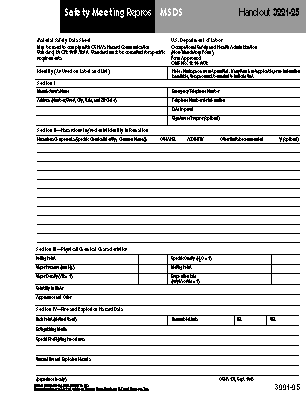
The MSDS covers:
I. Identity.
Manufacturer name and address and/or supplier information, emergency phone number, and date prepared.

II. Hazardous ingredients.
You'll find the substance's hazardous ingredients. Worker exposure limits to the chemical, such as the OSHA PEL, ACGIH TLV, and other recommended limits are also included. The only time you won't find the specific ingredients of a chemical is when it's protected as a trade secret. But the MSDS will still tell you about its hazards and the safety measures required.

III. Physical and chemical characteristics.
- ● Boiling point
- ● Vapor pressure
- ● Vapor density
- ● Melting point
- ● Evaporation rate
- ● Water solubility
- ● Appearance and odor under normal conditions.


IV. Physical hazards such as fire and explosion—and ways to handle those hazards, such as fire fighting equipment and procedures.

©1995 Business & Legal Reports, Inc.
Reproduction prohibited without license from
Safety Meeting Repros MSDS
Material Safety Data Sheets:
Your Lifeline (Sections V-VIII)
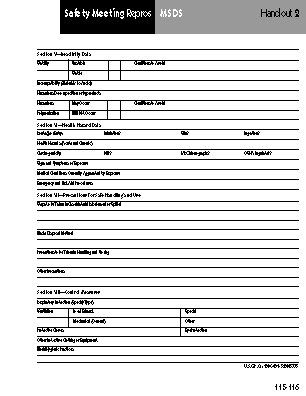
V. Reactivity
tells you whether the substance is stable. You'll learn which other substances and situations to keep it away from to prevent reaction.
VI. Health hazards.
This section will tell you how the chemical could enter the body, for instance:
- ● Inhaling
- ● Through the skin
- ● Swallowing
You'll also learn about all the possible health hazards that could come from exposure. If the chemical is believed to be a carcinogen, that will also be listed.

Health hazards also covers signs and symptoms of exposure, such as:
- ● Eye irritation
- ● Nausea
- ● Dizziness
- ● Skin rashes
- ● Headache
- ● Existing medical conditions that could be aggravated by exposure
- ● Plus emergency and first-aid procedures if an accident happens
- ● Any other precautions.
VII. Precautions for safe handling and use:
- ● What to do if the substance spills or leaks
- ● How to dispose of the substance
- ● Equipment and procedures needed for cleaning up spills and leaks.
Plus
- ● How to handle the substance properly
- ● How to store it
- ● Any other precautions
VIII. Control measures
to reduce harmful exposure are listed in this section.
You'll find out what type of
- ● Respirator
- ● Gloves
- ● Eye protection
- ● Protective clothing
- ● Ventilation to use when handling the particular chemical.
Special work or hygiene practices that should be followed will also be included in Section VIII.
©1995 Business & Legal Reports, Inc.
This HTML version was generated with AI assistance and may contain errors or omissions. The original approved PDF remains the official document of record. An alternative accessible format is available upon request from the document creator in accordance with Title II of the ADA.