Hand Safety With Machines
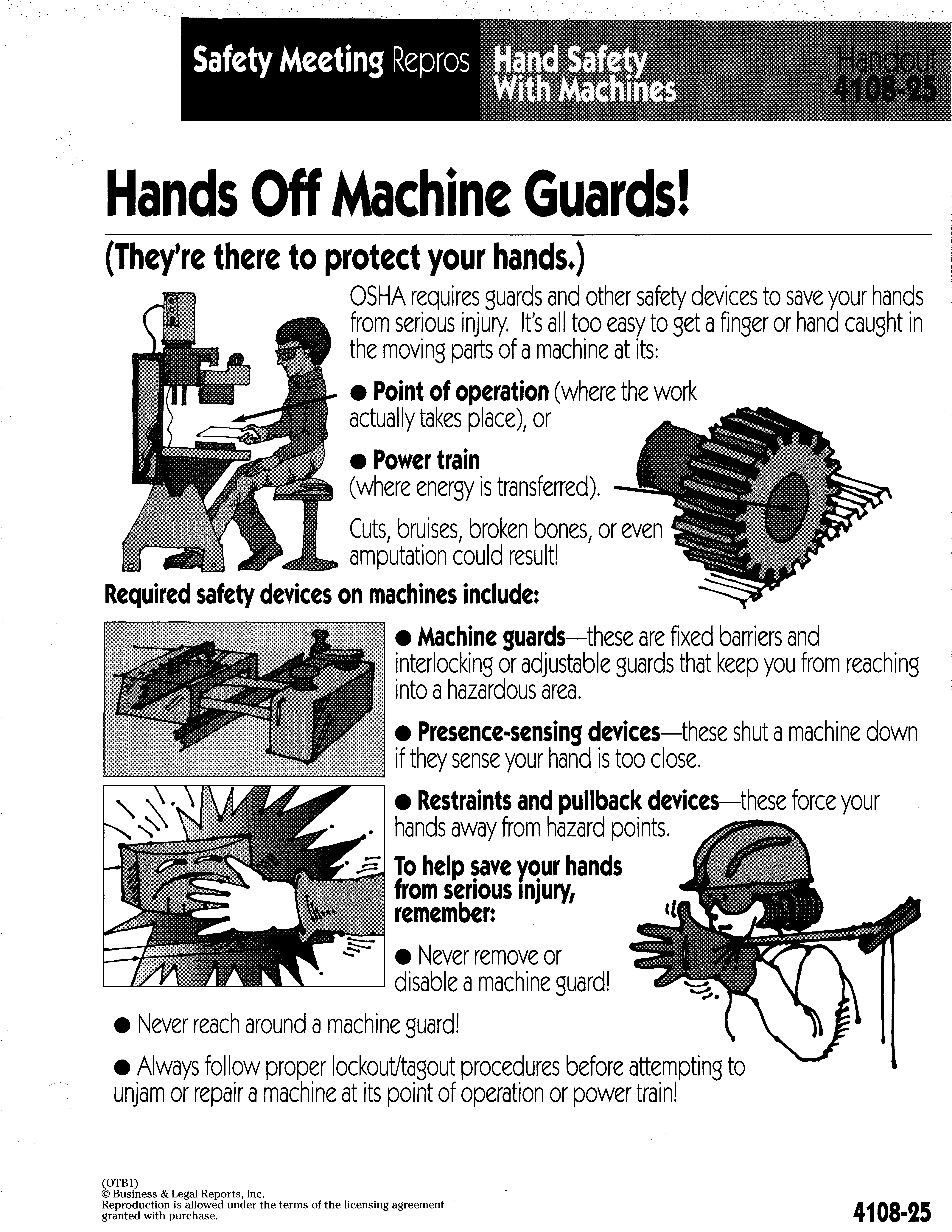
Hands Off Machine Guards!
(They’re there to protect your hands.)
OSHA requires guards and other safety devices to save your hands from serious injury. It’s all too easy to get a finger or hand caught in the moving parts of a machine at its:
- Point of operation (where the work actually takes place), or
- Power train (where energy is transferred).
Cuts, bruises, broken bones, or even amputation could result!
Required safety devices on machines include:
- Machine guards—these are fixed barriers and interlocking or adjustable guards that keep you from reaching into a hazardous area.
- Presence-sensing devices—these shut a machine down if they sense your hand is too close.
- Restraints and pullback devices—these force your hands away from hazard points.
To help save your hands from serious injury, remember:
- Never remove or disable a machine guard!
- Never reach around a machine guard!
- Always follow proper lockout/tagout procedures before attempting to unjam or repair a machine at its point of operation or power train!
(OTB1)
© Business & Legal Reports, Inc.
Reproduction is allowed under the terms of the licensing agreement granted with purchase.
4108-25
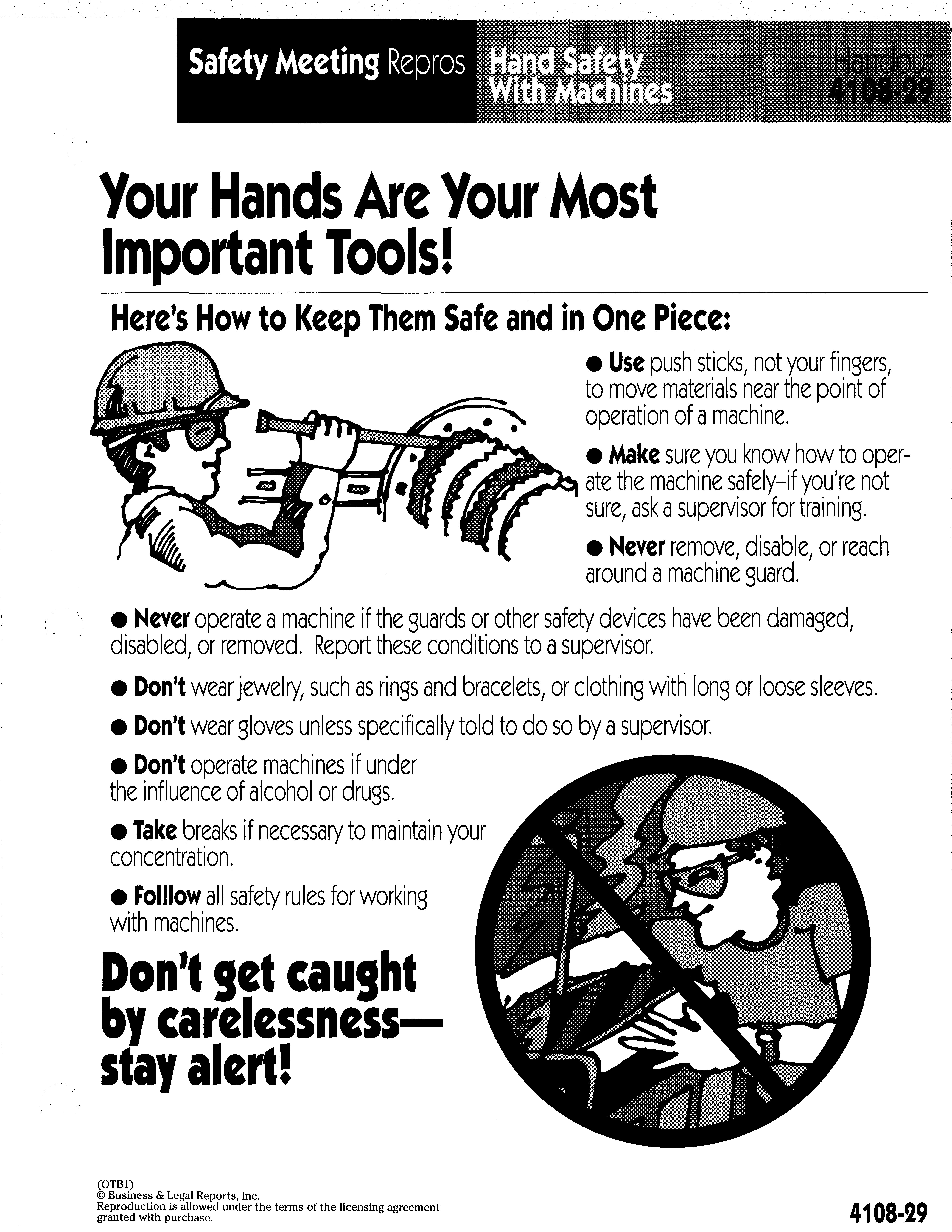
Your Hands Are Your Most Important Tools!
Here’s How to Keep Them Safe and in One Piece:
- Use push sticks, not your fingers, to move materials near the point of operation of a machine.
- Make sure you know how to operate the machine safely—if you’re not sure, ask a supervisor for training.
- Never remove, disable, or reach around a machine guard.
- Never operate a machine if the guards or other safety devices have been damaged, disabled, or removed. Report these conditions to a supervisor.
- Don’t wear jewelry, such as rings and bracelets, or clothing with long or loose sleeves.
- Don’t wear gloves unless specifically told to do so by a supervisor.
- Don’t operate machines if under the influence of alcohol or drugs.
- Take breaks if necessary to maintain your concentration.
- Follow all safety rules for working with machines.
Don’t get caught by carelessness—stay alert!
(OTB1)
© Business & Legal Reports, Inc.
Reproduction is allowed under the terms of the licensing agreement granted with purchase.
4108-29
KEEPING HANDS SAFE FROM MACHINERY QUIZ
Safety Meeting Repros
Keeping Hands Safe From Machinery
Handout 4108-33
After the following statements, write T for True or F for False:
- A machine that can cut, press, roll, or drill a piece of wood or metal can do the same thing to your hands. ____
- The point of operation and the power train are the two most hazardous areas of a machine. ____
- The point of operation is the point at which energy is transferred. ____
- The machines that you use may or may not include built-in safety devices. ____
- Machine guards, restraints, and pull-back devices are all forms of safety devices. ____
- If a machine is jammed at the point of operation, you can reach around the machine guard. ____
- Gloves should always be worn when working with machines. ____
- Presence-sensing devices sound an alarm when a body part comes too close to the machine. ____
- Always use push sticks rather than your fingers to position and move materials near the point of operation. ____
- A nip point is any place where a moving part comes close to or contacts another, or where two moving parts come together. ____
______________________________
Name (please print)
______________________________
Signature
______________________________
Date
99/09/OTB132
© Business & Legal Reports, Inc.
Reproduction is allowed under the terms of the licensing agreement granted with purchase.
4108-33.1
ANSWERS
Safety Meeting Repros
Keeping Hands Safe From Machinery
Handout 4108-33
After the following statements, write T for True or F for False:
- A machine that can cut, press, roll, or drill a piece of wood or metal can do the same thing to your hands. T
- The point of operation and the power train are the two most hazardous areas of a machine. T
- The point of operation is the point at which energy is transferred. F
The power train transfers energy; the point of operation is where the work actually takes place. - The machines that you use may or may not include built-in safety devices. F
OSHA requires machines to include safety devices. - Machine guards, restraints, and pull-back devices are all forms of safety devices. T
- If a machine is jammed at the point of operation, you can reach around the machine
guard. F
Never reach around a machine guard. - Gloves should always be worn when working with machines. F
Unless they are skintight, like surgical gloves, there’s a chance that gloves can be caught in machinery. - Presence-sensing devices sound an alarm when a body part comes too close to the machine.
F
They cause the machine to shut down when a body part gets too close. - Always use push sticks rather than your fingers to position and move materials near the point of operation. T
- A nip point is any place where a moving part comes close to or contacts another, or where two moving parts come together. T
4108-33.2
99/09/OTB132
© Business & Legal Reports, Inc.
Reproduction is allowed under the terms of the licensing agreement granted with purchase.
This HTML version was generated with AI assistance and may contain errors or omissions. The original approved PDF remains the official document of record. An alternative accessible format is available upon request from the document creator in accordance with Title II of the ADA.