Foot Protection
A. Lesson Goal
By the end of the training session, workers will:
- Understand the potential for painful (and possibly crippling) foot injuries on the job.
- Recognize the need for commonsense safety precautions.
- Appreciate the importance of proper protective footwear for the job.
B. OSHA Regulation: 1910.136
C. Have Handy
- Samples of each type of protective footwear used by your company.
- A volunteer model to demonstrate proper fit of footwear.
D. Background for Instructor
1. Introduction
Every day hundreds of workers suffer foot injuries on the job. This figure translates to well over 100,000 foot injuries a year. According to the National Safety Council, the great majority of those injured do not wear any type of protective footwear. Most of them claim to dislike wearing protective footwear or to be unaware of its benefits.
From a stubbed toe to an amputated one, foot injuries vary greatly in type and severity. The foot contains 20 separate bones that together form an arch responsible for supporting the entire weight of the body. This marvel of anatomical engineering is understandably vulnerable to injury under even everyday circumstances. (Consider how easy it is to sprain an ankle.)
The potential for foot injury in the workplace can be great—in fact, up to 10 percent of all disabling injuries on the job are injuries to the foot and toe. That’s why OSHA regulations require protective footwear in all circumstances in which foot injuries are likely to occur. And it’s why workers need to appreciate the need to protect their feet and comply willingly with company guidelines for foot protection on the job.
2. Hazard Communication
Employees should be made aware of all the issues that can affect foot safety in the workplace, including:
- Job-specific hazards—heavy, moving, or falling objects or machinery.
- Environmental factors—loose carpet, wet or slippery conditions.
- Protective footwear features—good fit, support, and condition.
- General safety precautions—avoid horseplay; walk, don’t run.
3. Hazard Identification
The major hazards to the foot and toes in the workplace include impact (from dropping heavy materials such as tools or parts on your foot, or having objects like this fall on your feet); compression (from heavy objects such as carts or pipes rolling over your feet); and puncture injuries (from stepping on sharp objects such as nails, wire, tacks, scrap metal, etc.). Other common injuries range from stubbed toes to slips and electrical or chemical burns. Following is a list of potential hazards to foot safety:
- Impact
- Compression
- Puncture
- Electrical, fire, explosion
- Wet surfaces
- Hot surfaces
- Extreme cold
- Welding sparks; molten splashes
- Chemical or corrosive splashes
4. Basic Prevention
OSHA requires that all safety shoes meet criteria set by the American National Standards Institute (ANSI). Impact, compression, and puncture injuries can often be prevented by wearing steel-toed shoes with appropriate add-on features (such as metatarsal guards, flexible metal soles, shin guards, and puncture-proof inserts). Other safety shoe features designed for specific situations include these:
- Electrical, fire, explosion—shoes, overshoes, or boots of fire-resistant materials with nonconductive soles; no metal nails, eyelets, or other metal parts.
- Wet surfaces—lined rubber shoes, overshoes, or boots with rubber, wooden, or synthetic soles to prevent slipping.
- Hot surfaces—wooden soles.
- Extreme cold—shoes or boots with insulated, water-repellent lining; insulated socks.
- Welding sparks; molten splashes—easy-to-remove “gaiters” or elastic-sided foundry boots; no laces or eyelets to trap splashes or sparks.
- Chemical or corrosive splashes—rubber or neoprene boots with synthetic stitching; check MSDSs for specific chemical safety.
5. Basic Footgear Criteria
Choosing the right footgear for the job is critical. In addition, the shoe or boot must fit comfortably. A shoe or boot that’s too loose or too tight may provide its own hazards. When you are fitted for footgear, try to schedule the fitting on the day when your feet are likely to be at their largest (because of swelling over the course of the day).
Footwear should generally be made of leather, rubber, or a strong synthetic material and should feature:
- Good support
- Nonskid soles
- Low heels
- Strong, sturdy laces or other secure fasteners
Finally, protective footwear must be maintained in good condition in order to do its job. Employees should check their shoes for wear or damage each time they put them on.
E. Examples and Practical Exercises
- Ask participants to list the major hazards to foot safety they face in their jobs.
- Ask participants to detail any objections (they’re ugly, expensive, uncomfortable, clumsy, unnecessary) to the use of protective footwear. Be prepared to rebut these arguments with facts.
- Ask participants to recall near-miss accidents—or actual incidents that could easily have caused foot injury—in their departments.
A Safety Meeting Outline
(Note: This outline can be divided into two parts so that you can cover the lesson in one meeting or two shorter meetings.)
Part I: Hazard Recognition
A. Introduction — 2 minutes
- There are hundreds of foot accidents daily in the workplace, and well over 100,000 injuries annually.
- Most victims of foot accidents were not wearing safety shoes at the time they were injured.
- Overcoming resistance to safety shoes and reinforcing the benefits of foot protection are key to reducing workplace injuries.
B. Hazard Communication — 5 minutes
(Distribute and discuss Handout 4131-25, Safety Afoot.)
Discuss the different issues to consider in regard to foot protection, including job-specific hazards, environmental factors, protective footwear features, and general safety precautions.
C. Hazard Identification — 5 minutes
- Impact injuries—heavy objects such as tools, packages, and parts drop or fall onto the foot.
- Compression injuries—heavy objects such as manual carts or heavy pipes roll over the foot.
- Puncture injuries—the victim steps on a nail, tack, wire, scrap metal, etc.
- Electrical, fire, explosion injuries—burns or electrocution can result.
- Wet surfaces—slips can cause strains, sprains, or nasty falls.
- Hot surfaces—soles of feet can be burned.
- Extreme cold—numbness or frostbite can result.
- Welding sparks; molten splashes—burns can result.
- Chemical or corrosive splashes—burns can result.
D. Discussion and Practical Exercises — 4 minutes
- Ask participants to list the major hazards to foot safety in their jobs.
- Ask how many participants avoid wearing safety shoes when they think they can get away with it.
- Ask participants to try to recall near-miss accidents on the job, or actual incidents that could have caused serious foot injury.
E. Wrap-Up — 2 minutes
- Thank employees for their participation.
- Ask for final questions and comments.
- Issue and collect session evaluation form.
Part II: Hazard Prevention
(If Part II is a separate meeting, review the critical points of Part I.)
A. Introduction — 2 minutes
- OSHA requires safety shoes to be worn in virtually all situations in which foot injuries are likely to occur.
- Safety shoes must meet criteria set by the American National Standards Institute (ANSI).
- In order to be effective, protective footwear must be chosen for the job at hand, properly fitted and maintained, and worn routinely.
B. Hazard Prevention — 6 minutes
- Impact, compression, and puncture injuries—steel-toed shoes with appropriate add-on features (metatarsal guards, flexible metal soles, shin guards, puncture-proof inserts, etc.).
- Electrical, fire, explosion—shoes, overshoes, or boots of fire-resistant materials with nonconductive soles; no metal nails, eyelets, or other metal parts.
- Wet surfaces—lined rubber shoes, overshoes, or boots with rubber, wooden, or synthetic soles to prevent slipping.
- Hot surfaces—wooden soles.
- Extreme cold—shoes or boots with insulated, water-repellent lining; insulated socks.
- Welding sparks; molten splashes—easy-to-remove “gaiters” or elastic-sided foundry boots; no laces or eyelets to trap splashes or sparks.
- Chemical or corrosive splashes—rubber or neoprene boots with synthetic stitching; check MSDSs for specific chemical safety.
C. Basic Footgear Criteria — 4 minutes
- Footgear should be chosen for a specific job or type of protection.
- The shoe or boot should be carefully fitted so that it’s neither too loose nor too tight.
- Protective footwear should be made of leather, rubber, or a strong synthetic material.
- Shoes or boots should have
- Strong support
- Nonskid soles
- Low heels
- Secure fasteners
- Footgear must be carefully maintained in order to do its job.
D. Discussion and Practical Exercises — 4 minutes
(Distribute and review Handout 4131-29, After an Accident, I Can Still Count My Toes.)
- Ask how many participants have had objections to safety shoes in the past. Do they still feel the same way? (Be prepared to rebut any arguments about comfort, cost, style, etc. with safety facts.)
F. Wrap-Up — 2 minutes
- Thank employees for their participation.
- Ask for final questions and comments.
- Issue and collect session evaluation form.
Handout 4131-25: Safety Afoot
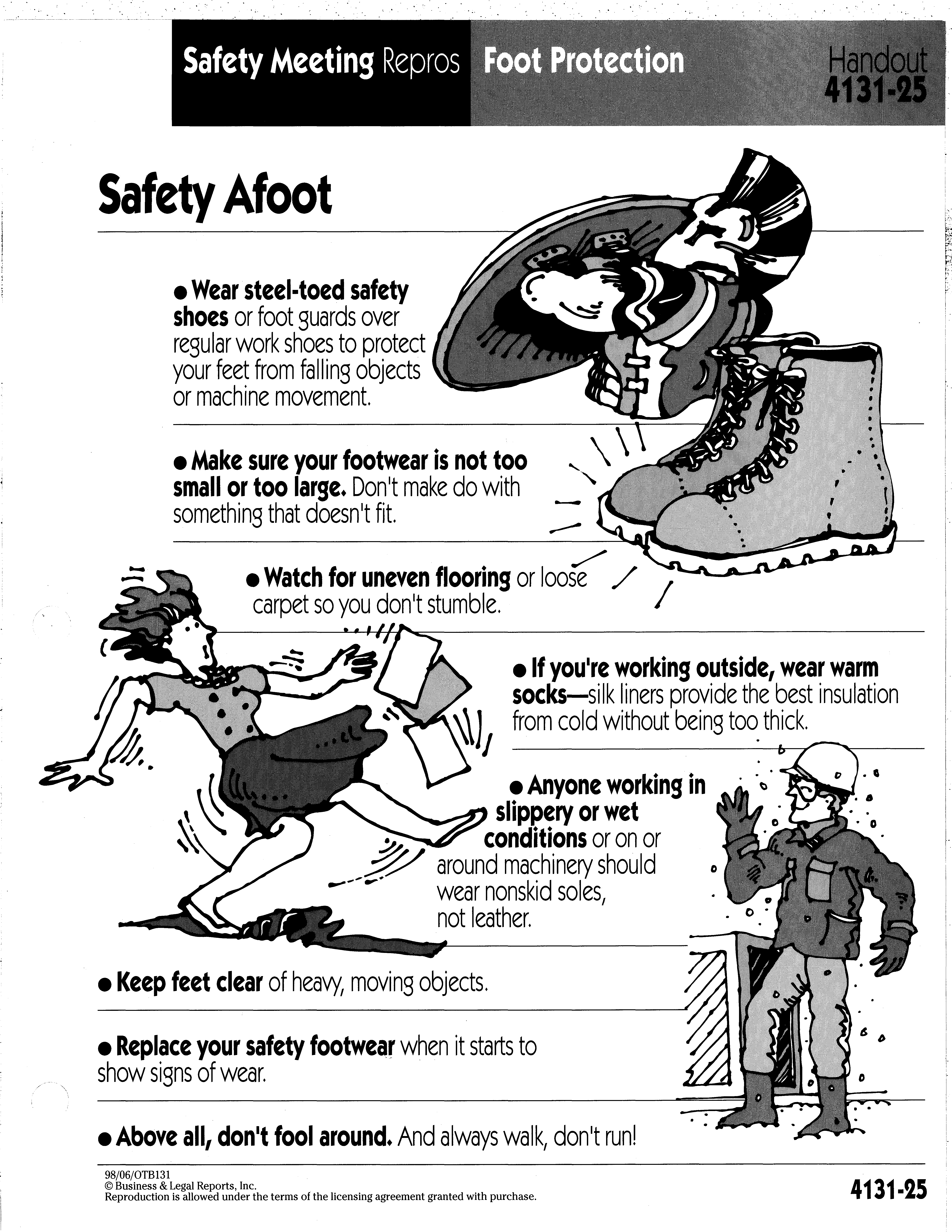
- Wear steel-toed safety shoes or foot guards over regular work shoes to protect your feet from falling objects or machine movement.
- Make sure your footwear is not too small or too large. Don’t make do with something that doesn’t fit.
- Watch for uneven flooring or loose carpet so you don’t stumble.
- If you’re working outside, wear warm socks—silk liners provide the best insulation from cold without being too thick.
- Anyone working in slippery or wet conditions or on or around machinery should wear nonskid soles, not leather.
- Keep feet clear of heavy, moving objects.
- Replace your safety footwear when it starts to show signs of wear.
- Above all, don’t fool around. And always walk, don’t run!
Handout 4131-29: After an Accident, I Can Still Count My Toes
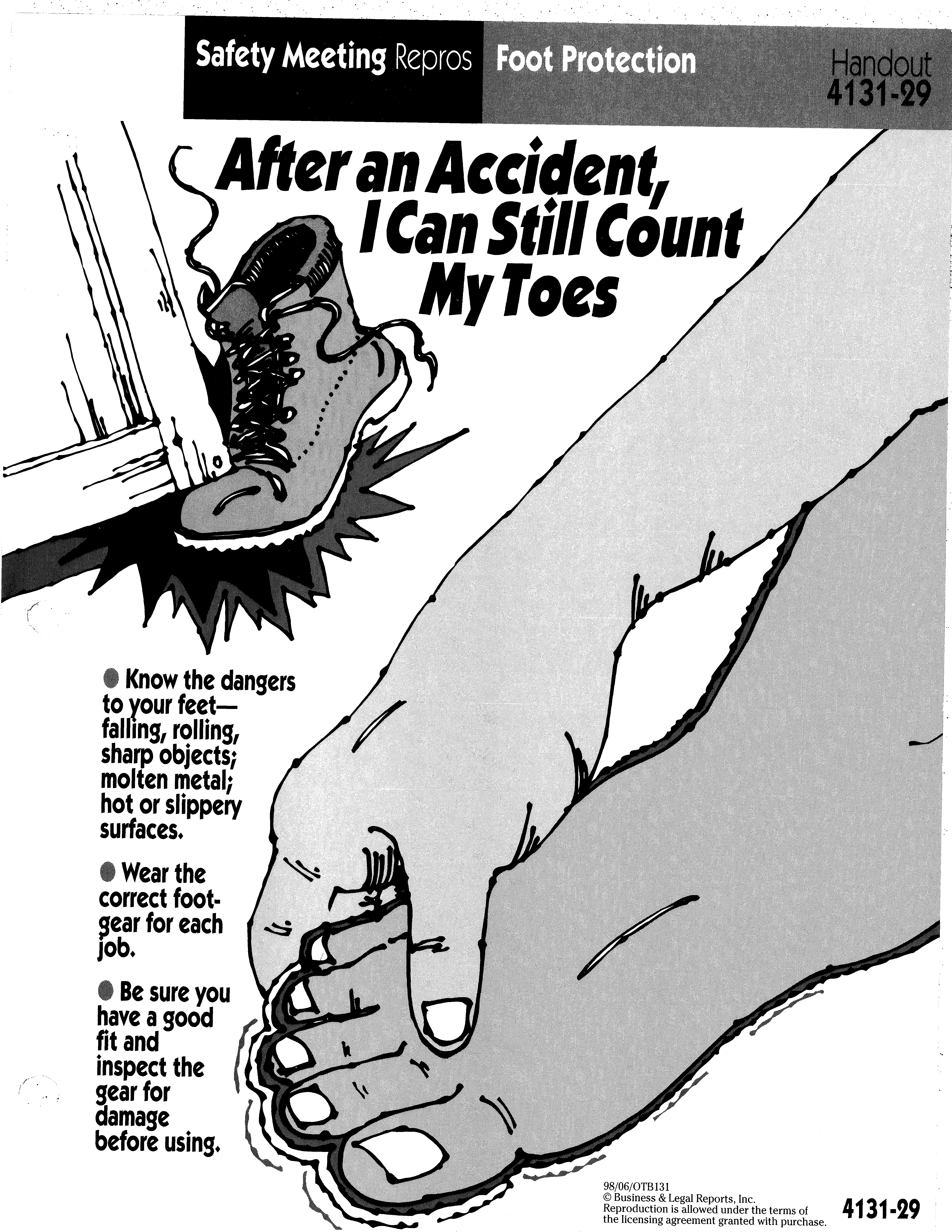
- Know the dangers to your feet—falling, rolling, sharp objects; molten metal; hot or slippery surfaces.
- Wear the correct footwear for each job.
- Be sure you have a good fit and inspect the gear for damage before using.
98/06/OTB131
© Business & Legal Reports, Inc.
Reproduction is strictly prohibited.
98/06/OTB131
© Business & Legal Reports, Inc.
Reproduction is strictly prohibited.
98/06/OTB131
© Business & Legal Reports, Inc.
Reproduction is allowed under the terms of the licensing agreement granted with purchase.
98/06/OTB131
© Business & Legal Reports, Inc.
Reproduction is allowed under the terms of the licensing agreement granted with purchase.
98/06/OTB131
© Business & Legal Reports, Inc.
Reproduction is allowed under the terms of the licensing agreement granted with purchase.
98/06/OTB131
© Business & Legal Reports, Inc.
Reproduction is allowed under the terms of the licensing agreement granted with purchase.
98/06/OTB131
© Business & Legal Reports, Inc.
Reproduction is allowed under the terms of the licensing agreement granted with purchase.
This HTML version was generated with AI assistance and may contain errors or omissions. The original approved PDF remains the official document of record. An alternative accessible format is available upon request from the document creator in accordance with Title II of the ADA.