First Aid for Eyes
A. Lesson Goal
By the end of the training session, workers will:
- Recognize potential eye hazards on the job.
- Understand proper first-aid treatment for different types of eye injuries.
- Be able to administer appropriate first aid for eyes in an emergency.
B. OSHA Regulation: 29 CFR 1910.133, 29 CFR 1910.151, and 29 CFR 1910.1200 plus regulations for specific substances that could damage the eye.
C. Have Handy
- Your company’s policy and procedures for dealing with medical emergencies in the workplace.
- Samples of eye protection used in your department.
- List of potential eye hazards in your department.
- First-aid kit.
D. Background for Instructor:
1. Introduction
Any eye injury is a serious concern. Most eye injuries require medical attention, and the call for emergency medical assistance should usually go out immediately. First aid while waiting for emergency medical help to arrive, however, can minimize damage, keep the victim calm, and help to treat the problem. Responding quickly with appropriate first aid for an eye injury can make the difference between a quick recovery and permanently impaired vision. That’s why it is important for your employees to be familiar with the proper first aid for a variety of potential eye injuries. Of course, most injuries can be avoided if employees wear the proper eye protection on the job. This is a point you should emphasize at the beginning of the session.
2. Particles in the Eye
Employees should take the following steps in the event someone gets a particle in the eye:
- Do not rub the eye.
- Lift the upper eyelid outward and down over the lower lid, and let tears wash out the particle.
- If that does not work, flush the eye with water until the particle comes out.
- If the particle still does not wash out or if pain or redness continues, bandage the eye lightly and get medical attention.
3. Chemical Splashes or Burns
Chemical splashes or burns are extremely serious injuries that can cause permanent eye injuries. Quick action is required:
- Hold the eye open and use the emergency eyewash to flush with water for at least 15 minutes.
- Call for emergency medical assistance.
- Check the material safety data sheet (MSDS) for information about the chemical and supply this information to emergency medical personnel.
4. Light Burns
In the event of a burn caused by intense light (such as a laser beam or infrared radiation from welding), employees should remember the following information:
- You may not feel anything for up to a day.
- Then you may experience a gritty sensation, light sensitivity, redness, or swelling.
- Keep eyes closed and get medical attention.
5. Blow to the Eye
First aid for blows to the eye involves the following steps:
- Apply a cold compress without pressure for 15 minutes to reduce pain and swelling.
- Get medical attention at once if pain continues or if vision is affected.
6. Penetrating Object in the Eye
If the eye is cut, punctured, or penetrated, the first step is to call for emergency medical assistance immediately. Then:
- Do not remove, move, or put pressure on any object that has penetrated the eye.
- Immobilize the object by placing a paper cup or soft, bulky dressing around the object and securing it in place with a bandage.
- Bandage both eyes so that the victim will keep the injured eye still.
7. Cuts Near the Eye
When administering first aid for cuts near the eye:
- Bandage loosely and get medical attention.
- Don’t rub the eye.
E. Examples and Practical Exercises:
- Review your company’s policy and procedures for dealing with eye injuries in the workplace (including use of the emergency eyewash if you have one).
- Discuss potential eye hazards in your department.
- Display various types of eye protection used in the department and briefly explain the circumstances under which each type should be worn.
- Show employees a first-aid kit, tell them where they can find such kits in the work area, and go through the contents of the kit, pointing out items that may be required to administer first aid for eye injuries.
03/12/OTB133
© Business & Legal Reports, Inc.
Reproduction is strictly prohibited.
A Safety Meeting Outline
Note: If your company has an emergency eyewash station, hold your training session nearby to demonstrate its proper use.
A. Introduction
2 minutes
- Any eye injury is a serious concern.
- Responding quickly with appropriate first aid for an eye injury can make the difference between a quick recovery and permanently impaired vision.
B. Medical Treatment
2 minutes
- Most eye injuries need prompt medical attention.
- First aid is not meant to be a substitute for professional help.
- In most cases, while someone is giving first aid, a co-worker should be calling for emergency medical assistance.
C. First Aid for Eyes
10 minutes
(Distribute and review Handout 4126-25, or use as an overhead slide.)
D. Discussion
5 minutes
- What should you do if you or a co-worker gets a particle in the eye?
- What should you do in the event of a chemical splash or burn?
- What should you do if you or a co-worker gets a blow to the eye?
- What should you do if an object penetrates someone’s eye?
- What is the proper first-aid treatment for cuts near the eye?
E. Summary
2 minutes
- Treat all eye injuries seriously, and take immediate action to administer appropriate first aid.
- Call for emergency medical assistance.
- Remember that the first rule of first aid is “Do no further harm.” If you’re not sure about what to do, simply calm and reassure the patient while you wait for emergency medical help to arrive.
F. Wrap-Up
3 minutes
- Thank employees for their participation.
- Ask for final questions and answers.
- Issue and collect session evaluation form.
03/12/OTB133
© Business & Legal Reports, Inc.
Reproduction is allowed under the terms of the licensing agreement granted with purchase.
First Aid for Eye Injuries
Most eye injuries need prompt medical attention. While help is on the way, however, you can help by calming and reassuring the victim and providing appropriate first aid. A quick response to an eye injury can make the difference between a speedy recovery and permanently impaired vision.
Particles in the Eye
- Do not rub the eye.
- Lift the upper eyelid outward and down over the lower lid, and let tears wash out the particle.
- If that does not work, flush the eye with water until the particle comes out.
- If the particle still does not wash out, or if pain or redness continues, bandage the eye lightly and get medical attention.
Chemical Splashes or Burns
- Hold the eye open and use the emergency eyewash to flush with water for at least 15 minutes.
- Call for emergency medical assistance.
- Check the material safety data sheet (MSDS) for information about the chemical and supply this information to emergency medical personnel.
Light Burns
- You may not feel anything for up to a day.
- Then you may experience a gritty sensation, light sensitivity, redness, or swelling.
- Keep eyes closed and get medical attention.
Blow to the Eye
- Apply a cold compress without pressure for 15 minutes to reduce pain and swelling.
- Get medical attention at once if pain continues or if vision is affected.
Penetrating Object in the Eye
- Call for emergency medical assistance immediately.
- Do not remove, move, or put pressure on the object.
- Immobilize the object by placing a paper cup or soft, bulky dressing around the object and securing it in place with a bandage.
- Bandage both eyes so that the victim will keep the injured eye still.
Cuts Near the Eye
- Bandage loosely and get medical attention.
- Don’t rub the eye.
03/12/OTB133
© Business & Legal Reports, Inc.
Reproduction is allowed under the terms of the licensing agreement granted with purchase.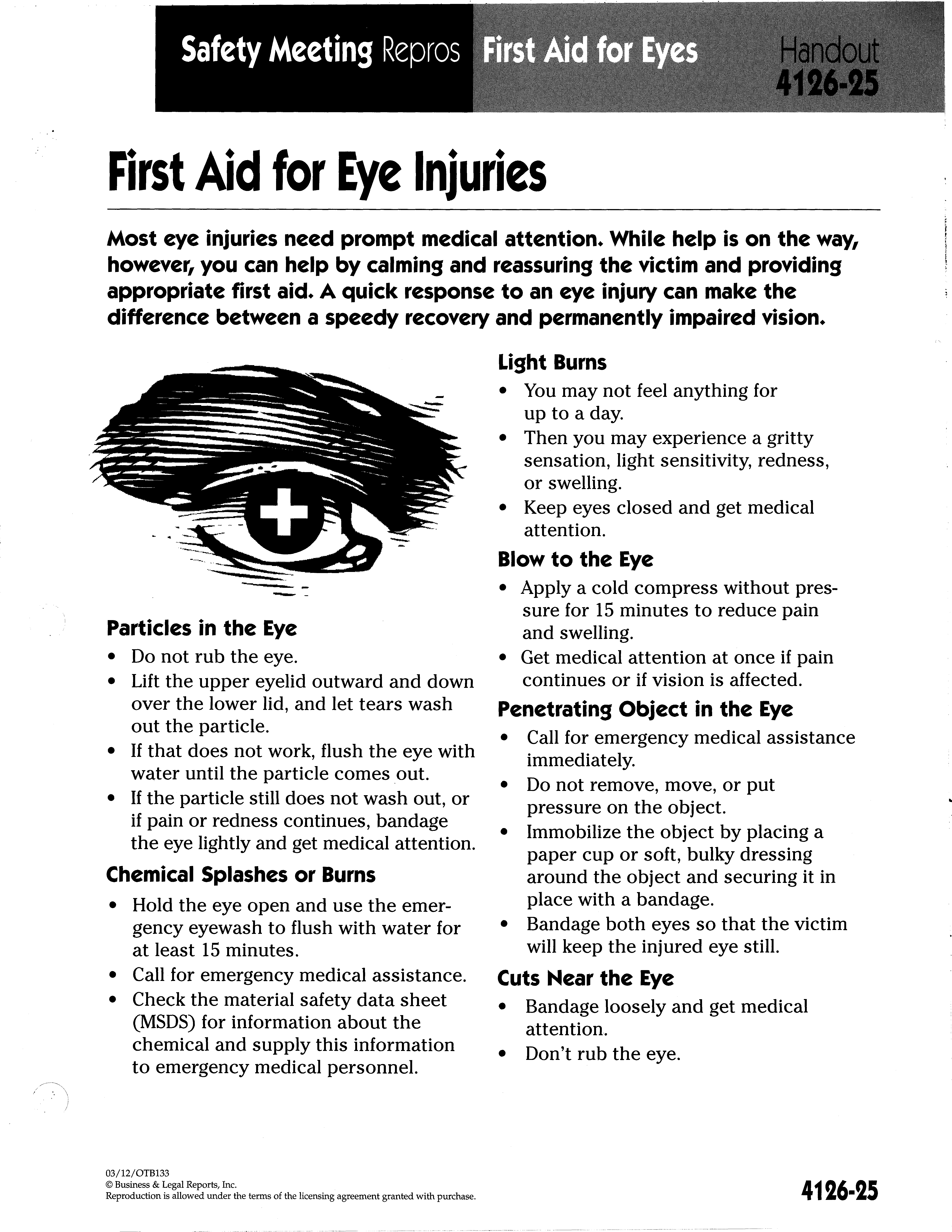
First Aid for Eyes Quiz
After the following statements, write T for True or F for False:
- If you or a co-worker gets chemicals in the eye, you should cover the eye and seek medical attention. ____
- The proper first aid for a blow to the eye is to apply a steak to the eye. ____
- The best way to get a particle out of your eye is to rub it until the tears wash the particle out. ____
- If a particle still does not wash out or if pain or redness continues, bandage the eye and get medical attention. ____
- If an eye is cut or punctured, apply a cold compress and get medical attention. ____
- Most eye injuries require prompt medical attention. ____
- If an object penetrates the eye, you should apply pressure around the object to stop bleeding. ____
- Proper first aid for cuts near the eye involves washing the cuts with soap and warm water before applying a sterile dressing. ____
- Unlike other eye injuries, blows to the eye rarely require medical attention. ____
- Most eye injuries can be prevented if you wear appropriate eye protection on the job. ____
Name (please print)
Signature
Date
03/12/OTB133
© Business & Legal Reports, Inc.
Reproduction is allowed under the terms of the licensing agreement granted with purchase.
ANSWERS
- If you or a co-worker gets chemicals in the eye, you should cover the eye and seek
medical attention. F
You should immediately flush the eye with water for at least 15 minutes and have someone call for emergency medical attention while you are flushing the eye.
- The proper first aid for a blow to the eye is to apply a steak to the eye. F
The proper first aid for a blow to the eye is to apply a cold compress.
- The best way to get a particle out of your eye is to rub it until the tears wash the
particle out. F
Never rub the eye. Instead, try lifting the upper eyelid outward and down over the lower lid, and letting tears wash out the particle. If that doesn’t work, flush the eye with water until the particle comes out.
- If a particle still does not wash out or if pain or redness continues, bandage the eye and get medical attention. T
- If an eye is cut or punctured, apply a cold compress and get medical attention. F
Call for emergency medical assistance immediately. Bandage both eyes so that the victim will keep the injured eye still.
- Most eye injuries require prompt medical attention. T
- If an object penetrates the eye, you should apply pressure around the object to stop
bleeding. F
Call for emergency medical assistance. Do not remove, move, or put pressure on an object penetrating the eye. While waiting for help to arrive, immobilize it by placing a paper cup or soft, bulky dressing around the object and securing it in place with a bandage, and then cover both eyes.
- Proper first aid for cuts near the eye involves washing the cuts with soap and warm
water before applying a sterile dressing. F
Bandage the area loosely and get medical attention.
- Unlike other eye injuries, blows to the eye rarely require medical attention. F
Blows to the eye require medical attention if pain continues or vision is affected.
- Most eye injuries can be prevented if you wear appropriate eye protection on the job. T
03/12/OTB133
© Business & Legal Reports, Inc.
Reproduction is allowed under the terms of the licensing agreement granted with purchase.
This HTML version was generated with AI assistance and may contain errors or omissions. The original approved PDF remains the official document of record. An alternative accessible format is available upon request from the document creator in accordance with Title II of the ADA.